Affiliate disclosure: This guide currently uses ordinary provider and source links without affiliate tracking. Gofarly may earn a commission from qualifying purchases through affiliate links elsewhere on this site. As an Amazon Associate I earn from qualifying purchases. Affiliate availability does not determine our picks. Full disclosure.
Choose the Eagle Creek Pack-It Isolate Compression S/M Set if you want a small, purposeful compression system. Choose a Peak Design Packing Cube when clean-and-dirty separation matters during the trip. Choose Away’s Insider Set of Four when you mainly want visible clothing organization in a suitcase. Buy around your bag and laundry routine, rather than the largest bundle.
The quick decision
| Scenario winner | Pick | Useful distinction | Main trade-off |
|---|---|---|---|
| Top pick for a compact compression setup | Eagle Creek Pack-It Isolate Compression S/M | Two different cube sizes with compression zippers | Fewer separate categories than a larger set |
| Best for managing worn clothing | Peak Design Packing Cube | Internal clean/dirty divider and compression | Choose sizes carefully rather than assuming one cube fits any bag |
| Best for visible suitcase organization | Away Insider Packing Cubes, Set of Four | Different shapes and mesh tops | Designed around organization and the suitcase’s compression system |
We are choosing different systems, not claiming an independently measured packing-volume winner. A low-cost cube you already own may be enough if you only need to separate socks from shirts. None of these removes the weight of the clothes inside.
Decide what problem the cube must solve
There are three distinct jobs: holding a category together, compressing soft clothing, and separating clothing at different stages of use. Write down which one actually slows you down on a trip. That prevents a simple organization problem from becoming a purchase of multiple specialized containers.
Measure the inside of your bag around fixed features such as wheel housings or internal dividers. Compare a cube’s footprint and its packed depth, leaving room for irregular items. A cube that fills the whole compartment neatly can be frustrating if it traps the jacket you need during a transfer.
Begin with fewer cubes than the packing diagram suggests. One for clothing and one for small garments is an effective experiment. Leave toiletries, chargers and items used in transit where they can be reached safely. Our one-bag backpack comparison covers how the main bag’s layout changes this decision.
1. Eagle Creek Pack-It Isolate Compression S/M: a focused starting set
The current set contains one small and one medium compression cube. Eagle Creek lists translucent fabric, handles and a second zipper for compression. Its specification table gives a combined listed weight of 136g. Check the official Isolate Compression S/M page for the present dimensions and materials, which differ from some older Isolate listings.
This is our starting recommendation because two cubes encourage a clear packing system. Put softer everyday clothing in the larger one and small garments in the smaller one. If the load still does not fit, remove a low-priority item before buying a third organizer. Compression is most useful when you already know which clothing is necessary.
- Pros: a limited two-cube system; separate small and medium formats; handles and translucent material for identifying contents.
- Cons: less direct visibility than a large mesh panel; compressing soft items can leave a rigid parcel that does not match every bag shape.
- Best for: a traveler who wants to reduce loose clothing without building a complicated system.
- Skip it if: your main goal is separating many family members’ items or maintaining a clean/dirty division in the same cube.
Use the compression zipper gently and stop if fabric is caught. The existence of a compression mechanism is not permission to force every item into a fixed space. Pack an indoor trial load that lets you see whether the two compressed parcels sit naturally inside your bag.
2. Peak Design Packing Cube: best when laundry changes the layout
Peak Design describes a cube with an internal divider for clean and dirty clothing, a compression zipper and a wide-opening access design. Different sizes are offered. The current product page explains the divider and its intended use; choose the size listed for the actual item you order.
We would choose this when your packing pattern changes each day. On the first morning, almost everything is clean. Later, more of the same limited clothing allowance is waiting for a wash. A divider can let you keep those two categories in one organizing unit instead of starting with a second empty cube that only becomes useful halfway through the trip.
- Pros: an explicit clean/dirty arrangement; compression; several size choices.
- Cons: additional features are unnecessary if you already use a separate laundry sack; a divider is not a watertight or odor-proof barrier.
- Best for: one-bag travelers who want a repeatable routine for worn clothing.
- Skip it if: you mainly carry delicate structured garments or want the simplest low-feature pouch.
Do not confuse compartment separation with hygiene treatment. Wet clothing should not be shut away for days just because the cube has two sides. Plan how you will dry and wash clothing. The best organizer cannot solve an itinerary that provides no realistic time for either task.
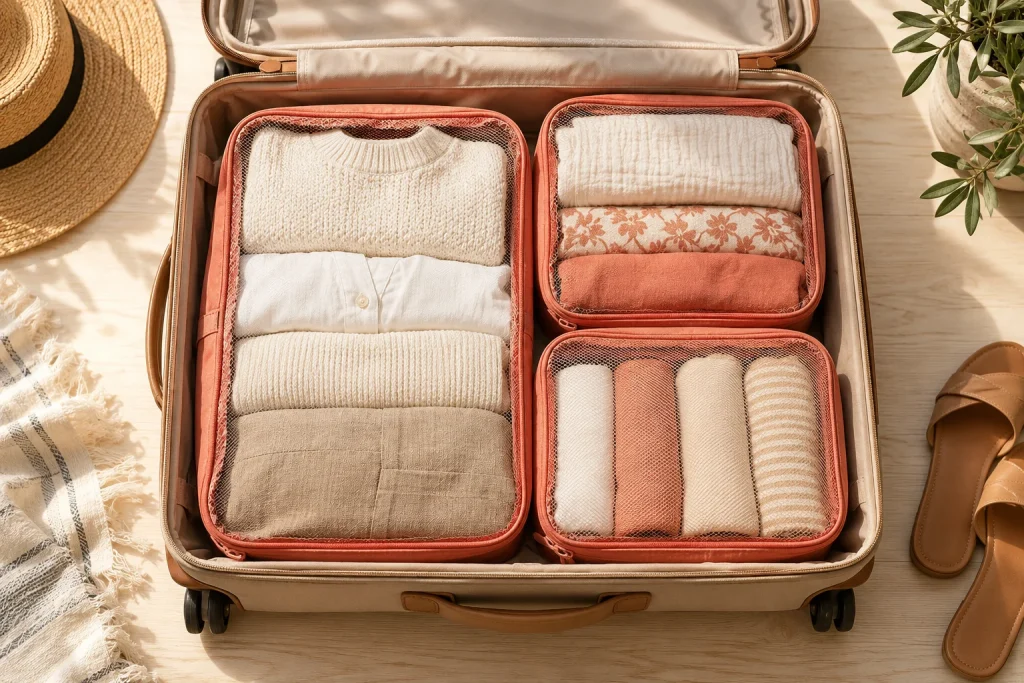
3. Away Insider Set of Four: best for seeing categories quickly
Away’s set has four different cube shapes, water-repellent nylon bodies and mesh tops. Away describes the set as working with its suitcase compression system. These are not the same product as a dedicated second-zipper compression cube. See the official four-piece set for the current shapes and care instructions.
Choose it if you want a clear, drawer-like organization system in a suitcase. Assign each cube a job before packing: shirts, underwear, small accessories, or another category that genuinely needs its own container. If one remains empty, leave it at home. Owning four does not create an obligation to carry four.
- Pros: mesh visibility; several shapes; a format intended to coordinate with Away luggage.
- Cons: a four-piece bundle may be more than a small backpack needs; mesh panels do not make a waterproof container; compatibility with another suitcase should be checked.
- Best for: suitcase travelers who value finding a category without opening every pouch.
- Skip it if: you are specifically buying a clean/dirty divider or a dedicated compression-zip mechanism.
The main trade-off is access versus packing density. If you have to stack every cube tightly, you may still need to lift two out to reach the third. Arrange the most-used category nearest the opening, even if a different layout looks tidier in a photograph.
Build a system you can maintain on a tired evening
A useful packing system should survive a late arrival. Decide where tomorrow’s clothing goes, where worn items go, and which cube can leave the bag without disturbing electronics or toiletries. If the answer requires repacking everything, simplify the layout.
Try a two-stage test at home. First, pack the cubes into the bag and close it normally. Then remove one full day’s clothing and put the equivalent worn items back in a separate area. Repeat once. This reveals whether the system still works after departure, rather than only on the neat first packing day.
Keep liquids and sharp items in purpose-suitable containers. Water-repellent fabric is not leak containment. Check care instructions before washing, and let organizers dry fully before storage. For the bag itself, compare our carry-on suitcase picks.
Frequently asked questions
Do compression cubes save weight?
No. They add their own weight while changing how clothing occupies space. That can be useful for organization, but a bag over the allowance still needs a lighter load.
How many cubes should I buy first?
Start with one or two that fit a real category. Add another only when your trial packing shows a specific access or separation problem. A large matching set is optional.
Can I use these for wet swimwear?
They are not presented here as sealed wet bags. Use a container designed for that job, keep moisture away from electronics, and unpack wet clothing promptly.
Will cubes prevent wrinkles?
We have not tested wrinkle performance. Folding method, garment material and how tightly you pack matter. Avoid buying on an absolute wrinkle-free promise.
Should the cubes match my bag’s brand?
Only if their actual dimensions and layout work better for you. Compare the available interior space, not the logo. Brand coordination is a convenience, not a requirement.
Sources and review notes
Official pages checked October 23, 2026: Eagle Creek Isolate Compression Set, Peak Design Packing Cube, and Away Insider Set of Four. No packing-volume or durability tests were conducted. Return to the Travel Gear hub or read our editorial method.