Affiliate disclosure: This guide currently uses ordinary provider and source links without affiliate tracking. Gofarly may earn a commission from qualifying purchases through affiliate links elsewhere on this site. As an Amazon Associate I earn from qualifying purchases. Affiliate availability does not determine our picks. Full disclosure.
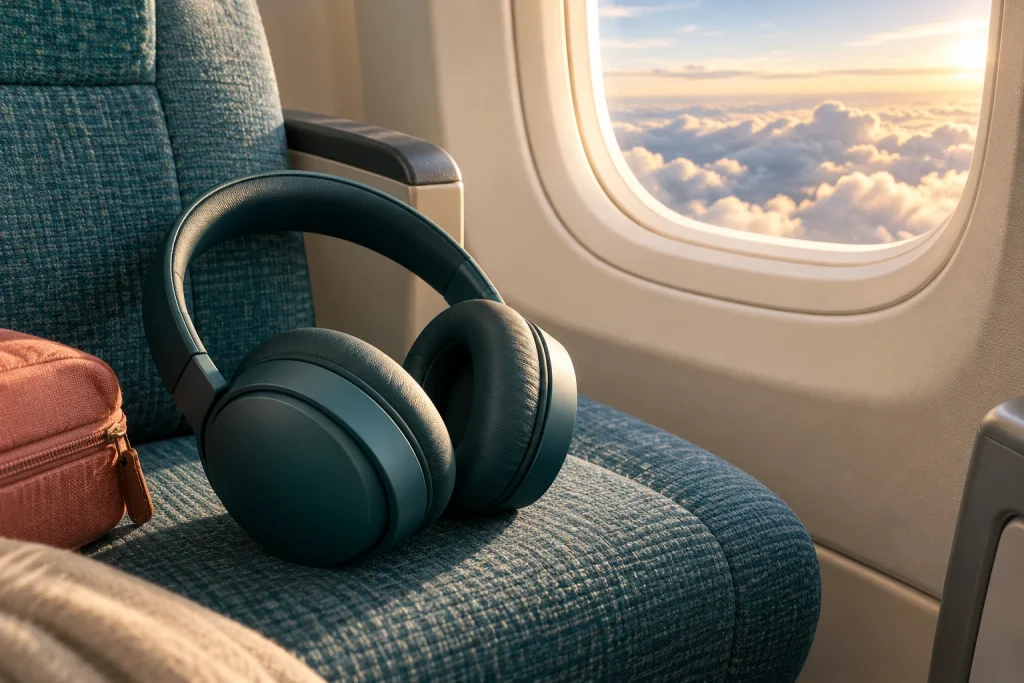
Start with Sony’s WH-1000XM6 for a versatile flight-and-everyday shortlist. Choose Bose QuietComfort Ultra Headphones (2nd Gen) when USB-C listening is a priority. Consider Sennheiser MOMENTUM 5 Wireless for a longer published battery reserve, or the older MOMENTUM 4 when its current price creates a worthwhile saving. Fit can overturn any of those recommendations.
The flight shortlist
| Scenario | Candidate | Published ANC-on battery claim | Main reason to compare |
|---|---|---|---|
| A versatile default shortlist | Sony WH-1000XM6 | Up to 30 hours | Bluetooth multipoint and a conventional wired input |
| USB-C audio from a phone or laptop | Bose QuietComfort Ultra Headphones (2nd Gen) | Up to 30 hours; less with Immersive Audio | USB-C audio plus an included analog cable |
| A newer model with a larger runtime reserve | Sennheiser MOMENTUM 5 Wireless | Up to 57 hours | Long published runtime and a user-replaceable battery |
| A previous-generation value opportunity | Sennheiser MOMENTUM 4 Wireless | Up to 60 hours | Worth comparing if the actual saving justifies older features |
We use scenario labels instead of declaring the strongest noise cancellation. A specification sheet cannot establish which seal works around your glasses or how a particular cabin, head position and listening level affect your experience. Avoid paying for a claimed winner that you cannot comfortably wear.
What matters more on a flight than at your desk
Begin with fit and the route to audio. Wear the headphones long enough to notice pressure at the headband, around the jaw and behind glasses, within the seller’s fitting and return rules. Check how the earcups sit when leaning against a seat or travel pillow. A good initial impression is useful, but it is not proof of all-night comfort.
Next, decide what you will listen to. A phone or laptop may support Bluetooth or USB audio. A seat screen may require an analog cable or a compatible transmitter. Do not assume the aircraft has Bluetooth, the correct jack or a working USB audio port merely because it has a charging socket.
Finally, leave runtime margin for delays and use before boarding. The listening settings used for a battery claim can differ between brands. A larger claimed number is useful for planning, but it does not establish a measured advantage in the same test.
Sony WH-1000XM6: the versatile starting shortlist
Sony’s WH-1000XM6 product page lists up to thirty hours with noise cancellation and Bluetooth multipoint. Its specifications also identify a stereo mini-jack input, a supplied connection cable and passive operation. Those are relevant travel features when entertainment sources vary.
We would start here for someone who wants one over-ear pair for flying, everyday listening and switching between personal devices. That is a recommendation about the mix of published features. It is not a conclusion that the XM6 cancels more aircraft noise than every competitor.
- Pros: conventional wired listening path; multipoint support; a published battery allowance suitable for many ordinary travel days.
- Cons: the thirty-hour figure is conditional; comfort remains unverified; a USB charging connection should not be assumed to provide every audio function you want.
Choose it if wired flexibility and a general-purpose setup matter. Skip it if its fit creates pressure or if your required audio connection is not supported. Confirm the exact source and cable combination rather than relying on the presence of a USB-C socket.
Bose QuietComfort Ultra Headphones (2nd Gen): for a USB-C audio setup
The second-generation Bose model supports USB-C audio and includes a 3.5mm-to-2.5mm analog cable. Bose advertises up to thirty hours of listening, or twenty-three with Immersive Audio. It also says the headphones can charge while being worn. These details distinguish this exact generation from older listings carrying a similar name.
Its strongest fit here is a traveler using a compatible USB-C phone or computer who values that wired option. USB audio is useful without becoming a reason to buy higher-resolution files or accessories you do not need. Confirm the port and operating-system support of the source device.
- Pros: USB-C audio; included analog cable; an official charging-while-listening capability.
- Cons: enabling extra audio modes changes runtime; the product name is easy to confuse with the first generation; we have not validated personal comfort or cabin performance.
Choose it if its wired options match your devices and the fit works for you. Skip it if a substantial price premium buys features you will rarely use. Check that the seller actually specifies QuietComfort Ultra Headphones, second generation, rather than earbuds or the standard QuietComfort range.
Sennheiser MOMENTUM 5 Wireless: for battery margin and service life
Sennheiser’s MOMENTUM 5 Wireless page lists up to fifty-seven hours with ANC and a user-replaceable battery. It is the newer MOMENTUM over-ear option in this comparison. We favor it for a traveler whose itinerary includes several listening days and who wants to consider battery replacement as part of ownership.
Replacement capability does not establish a battery’s eventual availability, price or lifespan. Follow the manufacturer’s procedure and check the support route in your country. Likewise, the advertised noise-cancellation improvement over an older model remains a manufacturer statement; we do not convert it into an independent score.
- Pros: a longer published listening reserve than the Sony and Bose figures listed here; user-replaceable battery; a current-generation feature set.
- Cons: no matched runtime or acoustic test from us; regional service details need checking; newer capabilities may not justify the difference for occasional flying.
Choose it if the runtime reserve and ownership features matter to you. Skip it if its fit is wrong or your real priority is the smallest packed setup. Do not compare loose headphone dimensions when you will carry a protective case.
Sennheiser MOMENTUM 4 Wireless: an older-model buying opportunity
The MOMENTUM 4 remains listed by Sennheiser, alongside the newer model. Its official page states up to sixty hours with ANC and lists a carry case, USB-C cable and auxiliary cable. We include it as a conditional value candidate rather than pretending it is the latest generation.
Look at the actual amount saved and the features surrendered. A previous model can be sensible when a substantial saving matters more than newer controls, battery replacement or other changes. A small saving is less compelling if you expect to keep the headphones for years.
- Pros: a long manufacturer runtime claim; published wired options; potential value when genuinely discounted.
- Cons: older feature set; the battery is not advertised as user-replaceable like MOMENTUM 5; remaining stock and support terms require checking.
Choose it if the current deal is materially better and its capabilities meet your needs. Skip it if the price is close to a newer candidate or the seller’s return and warranty arrangements are unclear.
Pack the connection, not just the headphones
Put the required audio cable in the headphone case and verify which end connects to the headphones. A familiar-looking jack can still use a different size on the earcup. If your aircraft requires an adapter or transmitter, verify that separately; it is not automatically included in every headphone box.
Charge before departure and check the behavior of your chosen listening mode. If you carry a battery pack, airline rules govern whether it can be used in flight. Our travel power-bank guide explains the separate carriage and use questions.
FAQ
Which model has the best noise cancellation?
We have not measured comparative attenuation, so we do not publish that ranking. Manufacturer ANC features help build a shortlist; they do not replace a fit check or comparable acoustic testing.
Can I use them with the seat-back screen?
Check the aircraft’s available output and the required cable. Bluetooth pairing and USB charging on a personal device do not prove compatibility with the seat system.
Should I buy the longest battery claim?
Only if the extra reserve solves your trip’s problem. Settings and test conditions vary. Comfort, packed size and the required connection can matter more than unused runtime.
Are earbuds a better flight choice?
They may save space, but fit, charging, connection options and sleeping comfort differ. This shortlist is specifically for over-ear headphones; it is not evidence that over-ear designs suit everyone.
Return to Travel Tech for the rest of your travel setup. The official sources linked above were checked on October 23, 2026; verify the exact generation before ordering.