Start with your devices, not a travel accessory bundle. A useful charging setup covers the devices you bring, works with your destination’s electrical supply and leaves you a practical backup when something fails.
The quick decision
| Your setup | Start here |
|---|---|
| Phone and small accessories | Compatible charger, correct cables and destination plug compatibility |
| Phone plus laptop or tablet | The device’s charging requirements and the charger’s output with multiple ports in use |
| Long days away from an outlet | A compatible power bank with readable specifications and a current airline-policy check |
| Several accommodation changes | A compact kit with an easy routine for checking that nothing stays in the socket |
1. Make a device list
List every item that needs charging: phone, headphones, watch, camera, e-reader, tablet and laptop. Record the connector each uses and the charging requirements given in its manual or by its manufacturer.
Decide which devices must charge together and which can take turns. Someone returning to the same room each evening has different needs from someone working between trains. Sharing chargers can reduce bulk, but only when the schedule and compatibility work.
2. Choose the charger around the demanding device
If you bring a laptop, start with its documented charging requirements. Check that the proposed charger supports the required charging standard and output. Do not assume that a matching USB-C connector proves the charger, cable and device can deliver the intended result.
For a charger with several ports, read the output table. Check the combination you plan to use, rather than only the largest figure printed on the box. A charger that suits one device alone may offer a different allocation when other devices are connected.
USB-IF’s Power Delivery guidance explains the role of USB Power Delivery. Your device and equipment documentation still determine which capabilities are available in your setup.
3. Treat cables as part of the system
Match each cable to the intended device and charging task. Check its stated power capability and connectors. If you also need to transfer files or connect a display, verify those capabilities separately.
The USB-IF cable guidance notes that cables have different capabilities. Certification does not give a cable or connected product capabilities it was not designed to support. Buy from an identifiable seller and keep the relevant specifications available.
Pack a length that works from an awkward bedside socket, then avoid duplicating every cable without a reason. A spare for the device you depend on most may be a more useful backup than several rarely used adapters.
4. Separate plug shape from electrical compatibility
A plug adapter changes the physical connection; it does not, by itself, convert voltage. Read the input label on the charger or appliance and check the destination’s electrical supply using reliable destination or electrical-safety information.
If you cannot establish compatibility, ask the manufacturer before using the equipment. Do not assume an adapter makes a hair appliance or another high-power device suitable abroad. Use an adapter with appropriate ratings and clear instructions, and stay within the limits of every component.
5. Choose a power bank only if the day needs one
Think about how long you will be away from outlets, how heavily you use the phone and what happens if its battery runs low. A power bank adds useful reserve but also weight and another device to charge.
Check capacity, output, charging input and the connectors you need. The printed battery capacity is not a promise of a fixed number of full phone charges; conditions and devices differ. Choose a model with a readable capacity label and accessible documentation.
Before flying, check your operating airline’s current rules for spare batteries and power banks, including placement, permitted use and any approval requirements. Do not apply a remembered universal limit to every itinerary.
6. Run through the setup before departure
At home, connect the devices in the combination you expect to use. Confirm that each indicates charging, inspect cables and plugs for damage, and check the manufacturer’s instructions if anything behaves unexpectedly. This is a basic compatibility check, not a laboratory safety certification.
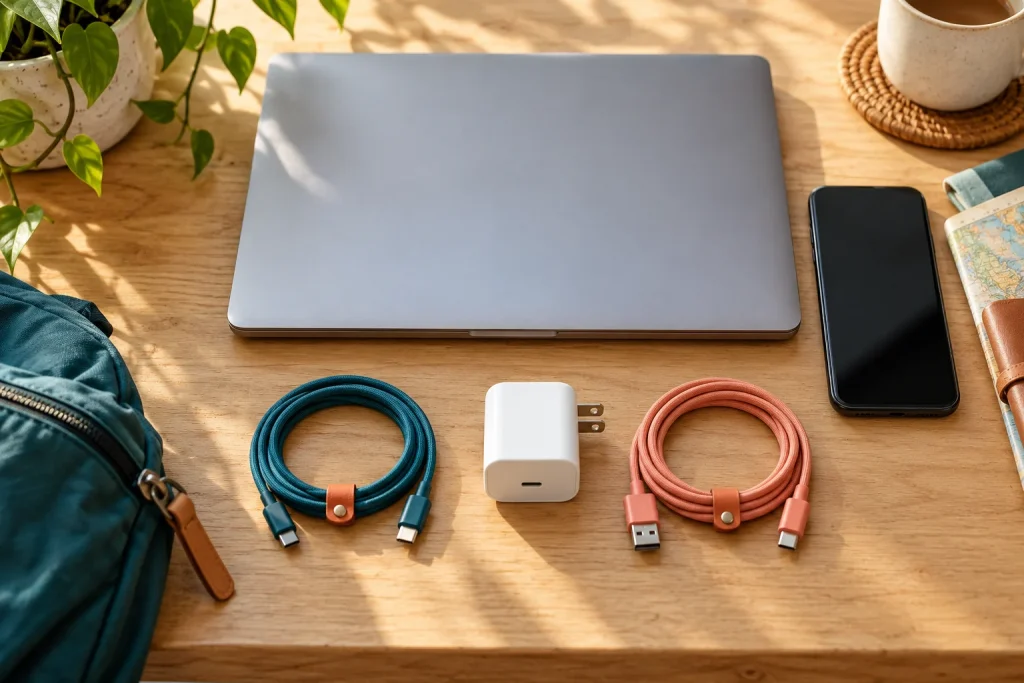
Keep the kit together and use a departure routine: check the wall socket, bedside surface and desk before leaving. Store critical cables where you can reach them in transit. Then weigh the complete kit as part of the load in your carry-on backpack.
For another pre-trip decision, read how to choose a travel eSIM, or return to Travel Tech.
Ready to compare specific options? Read travel power bank picks or travel adapter picks.